
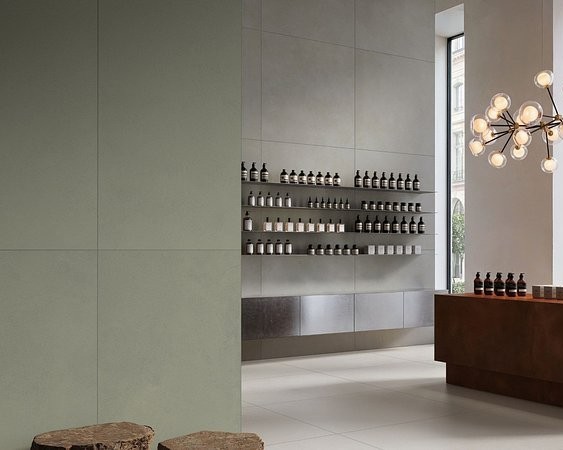
VitrA Tiles showcased its 2027 collections at the International Exhibition of Ceramic Tile and Bathroom Furnishings at Cersaie 2026, held in Bologna, Italy, this month. The ceramic tile brand welcomed architects, interior designers, customers and industry professionals, presenting its Material Intelligence concept, The Code, alongside new developments in ceramic tile technology.
The Code: three ceramic surface collections
At the centre of the presentation was The Code, VitrA Tiles’ Material Intelligence concept, bringing together three distinct design languages – Resincode, Geocode and Metacode.
Developed with contemporary architecture and interior design in mind, the three collections translate the textures, tones and surface qualities of natural and industrial materials into ceramic tile. The ranges offer architects and designers different approaches to specifying surfaces, from the mineral character of concrete and the geological variation of natural stone to the aged appearance of metal.
Resincode takes inspiration from the porous, mineral-rich appearance of natural concrete, combining subtle tonal transitions with layered surface effects. Its minimalist and refined aesthetic makes the collection suited to contemporary architectural and interior schemes.
Geocode draws on the geological character of Spanish limestone, marble, quartzite and gneiss. Four surface typologies – Alba, Imperio, Rio and Merano – interpret the natural variation and detailing of stone through a contemporary ceramic format, providing options for architects and designers looking to introduce a natural stone aesthetic into a tile specification.
Metacode explores the character of industrial materials through three surfaces inspired by gold, iron and copper. Subtle tonal shifts and soft reflections recreate the appearance of patinated metal, bringing an industrial influence to contemporary interior schemes.
VitrA Tiles introduces new surface technologies
Alongside its 2027 tile collections, VitrA Tiles also showcased two technology developments at Cersaie 2026: V-Flex and V-Tone.
V-Flex incorporates Välinge’s Ceraloc® locking technology to provide an adhesive-free tile installation system. Specially developed side profiles allow the tiles to be mechanically connected, with VitrA Tiles reporting installation times of up to five times faster than conventional bonded applications.
The system is designed to provide accurate alignment and consistent grout lines, while individual tiles can be removed and replaced when required. This offers potential practical benefits for architectural and commercial projects where ease of maintenance and access to individual tiles are important, including retail, hospitality, offices, showrooms and other commercial environments. V-Flex also incorporates acoustic properties.
Meanwhile, V-Tone focuses on colour consistency within ceramic tile production. The technology is designed to maintain tonal consistency and visual continuity across different surfaces, helping architects and designers achieve greater consistency within a specified tile scheme. Integration of V-Tone technology into VitrA Tiles’ production lines is ongoing.